

Agile Imitation
We are in a strange period of corporate imitation. Across the globe, organizations have adopted the terms of Scrum and Kanban, but the underlying structure stays waterfall & rigid, held back by old-fashioned thinking. You have the daily stand-ups, track velocity, and work in two-week sprints. Yet, when the market shifts or your product objectives change with little warning, the team responds with all the speed of a supertanker in a canal.
We have to ask an uncomfortable question: Are we actually agile, or are we just stuck in “Agile Theatre”?
The Illusion of Agile Adoption
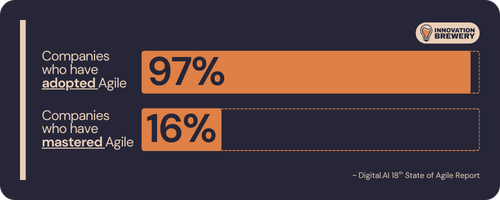
The data shows an odd contradiction. While agile adoption rates are incredibly high, 84% of organizations admit they haven’t actually become fully competent in these practices. We are seeing a massive “Agile Mastery Gap.”
This isn’t a failure of the frameworks themselves. It is a failure of the environment they are placed in. Most companies treat Agile as a simple patch for project management. They go through the motions of the sprint reviews and the retrospectives, but mistake these rituals for actual agility. This is the heart of the Agile Theatre problem: the appearance of progress without a change in how the organization actually thinks.
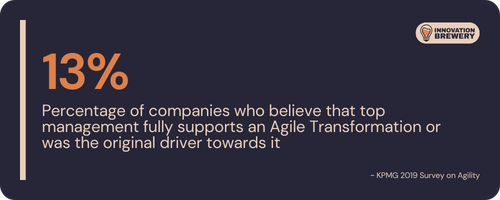
This performance usually happens in siloes, too. Research suggests that 74% of organizations feel their senior leadership doesn’t truly back agile initiatives. Without strategic support, agile stays a tactical hobby rather than a structural reality. It leads to an “agile performance,” where issues like scope creep or a focus on velocity over value are seen as the problem, rather than symptoms of a culture that refuses to share power.
From Methodology to Identity
To move past the agile theatre, we have to stop seeing agility as something a company “does” and start seeing it as what a company “is.” Real business agility is a strategic strength built into the company’s core.
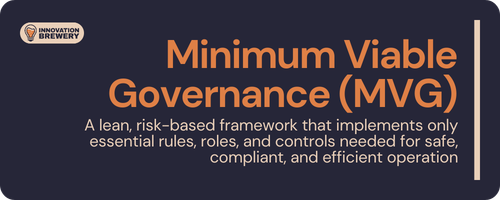
In a truly agile state, strategy is a living process, not a static plan sitting in a binder. It is iterative and designed to spot changes and transform in real-time. Doing this requires a major shift in governance. We need to move toward Minimum Viable Governance (MVG); a lightweight, modular setup that swaps heavy compliance for basic guardrails. MVG doesn’t try to control every move, but rather it gives teams the authority to make decisions where the information is freshest. This is the basis of any Agile framework, and the empowered teams accept the accountability that comes with it.
However, this decentralization won’t work without psychological safety. Agility requires the guts to fail and the openness to learn. If an organization punishes mistakes or fears a “red” status on a dashboard, it will never innovate. In those environments, communication becomes an act, and the “theatre” becomes a way for employees to survive when they know honesty is a risk to their careers.
The Path Forward: Product, AI, and Human Focus
Moving from theatre to identity means shifting from a “project” focus to a “product” focus. Where projects have a definitive end, products have life cycles. By focusing on continuous value rather than one-off deliverables, a company improves the entire customer journey.
In 2026, this identity also involves new skills and wider adoption. Strategic agility now requires AI literacy and ethical oversight. Skills that once belonged solely to the realm of IT have now become necessary parts for the entire company. The most agile organisations act as a single organism where technical skill and human-focused leadership work together. They realize that emotional intelligence is just as vital to the bottom line as the speed of a software pipeline.
If your organisation is stuck in a cycle of empty rituals, getting out requires structural changes:
- Focus on people instead of just the process: Stop worrying so much about the perfect Jira board and start building a culture of learning. Let cross-functional teams answer customer needs directly without waiting for permission from three layers of management.
- Simplify your governance: Audit your current rules. If your approval process takes longer than your development cycle, the system is broken. Replace rigid controls with lightweight frameworks that allow for independence within clear boundaries.
- Make your strategy move: Give up on the five-year plan. Move to a model of constant strategic updates based on real market data. Your strategy should be a hypothesis you are always testing, not a fixed decree.
- Build for total adaptability: Future-proofing isn't about guessing what will happen; it’s about building a system that can handle anything. This means investing in AI literacy, ensuring your supply chain can bounce back, and training leaders who lead with empathy.
The move from “doing agile” to “being agile” is the move from a performance to reality. It is time to close the curtain on the theatre and start the hard work of fixing the organizational core. Only then can we move from the slow inertia of a tanker to the fluidity of a living organism.
How Innovation Brewery can help:
Sources
- https://www.mckinsey.com/capabilities/people-and-organizational-performance/our-insights/successful-transformations
- https://assets.kpmg.com/content/dam/kpmg/pe/pdf/Publicaciones/TL/agile-transformation.pdf
- https://digital.ai/resource-center/analyst-reports/state-of-agile-report/
- https://resources.kanban.university/state-of-kanban/
- https://martyoo.medium.com/why-is-agile-not-working-41b6ab8de703


