AI is not enough on its own
By 2025, the hype cycle has hit a wall. For years, we’ve talked about AI as if it were magic, where we could pour enough data into old systems and it would somehow turn lead into gold. But as the “Great AI Rush” slows down, the truth is coming out: AI doesn’t save businesses, it just makes them move faster.
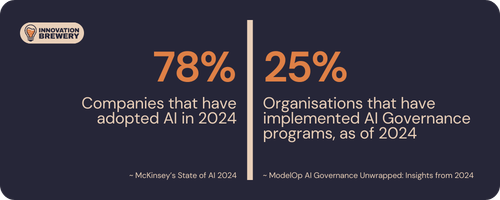
The numbers show a strange gap. While almost 80% of companies are rushing to adopt AI, only about 25% have any real governance in place. We’re essentially putting high-performance engines into horse-drawn carriages. This mismatch is exactly where most innovation fails.
Structural Management Issues
When you look at big AI failures, like IBM Watson Health or the struggles at Volkswagen’s CARIAD, the code usually isn’t the problem. The issue is almost always old-fashioned management. These projects die because of rigid hierarchies, fragmented data, and an inability to iterate.
If a company is messy, inefficient, and driven by fear, AI won’t fix it. It will just make those mistakes happen at machine speed. We’re seeing “automated chaos”, a situation where AI moves much faster than the people supposed to be in charge. It’s a control gap that’s getting harder to close.
Agility as the Foundation
Success with AI is a structural challenge as much as a technical one. Key skills aren’t limited to the data scientists and engineers. The leadership teams need to be able to create the environment for these technical experts to thrive. The organizations actually getting results are the ones that were already agile. They don’t see AI as a tool to buy, but as a team member to integrate.
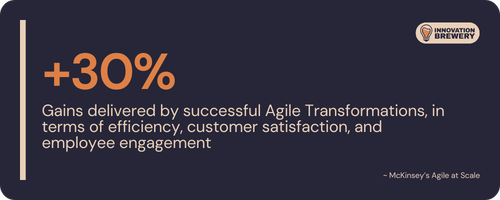
Agility is the groundwork here. As we move toward autonomous “Agentic AI,” we have to stop relying on static five-year plans. We need to give these systems clear goals and the room to pivot. When you put AI into an agile setup, it acts as a massive lever. It often boosts efficiency by 30% because it helps teams do more rather than just replacing them.
AI adoption requires people
We tend to think of “guardrails” as things that slow us down. In an agile setup, they’re actually what keep you safe while moving fast. Ethical frameworks shouldn’t be an afterthought, they belong in the daily workflow. This is the human side to consider. If people think AI is coming for their jobs, they’ll find ways to stop it from working. You can’t automate trust. AI only works in a culture where people can experiment and fail without looking over their shoulder.
AI can only transform a company as much as that company is willing to change. To close the gap, leadership needs a different focus:
- Solve the "Why" before the "How": Technology-first deployments are a vanity exercise. AI must be mapped to specific business problems and strategic goals from the outset.
- Embed governance into the flow: Move away from centralized, slow-moving approval boards toward cross-functional trust councils that live within the delivery cycle.
- Support adaptive leadership: Executives must move beyond traditional "command and control" to a model of dynamic funding and iterative results.
- Embrace Agile as framework: Use the dynamic and responsive frameworks that Agile provides to give structure to an otherwise messy, fragmented, and misaligned portfolio of AI pilots.
The bottom line is that AI is only as good as the organization using it. If you drop a powerful system into a rigid, fearful culture, you’re just going to make mistakes faster. To actually use AI, you have to be agile first. The tech is ready. The real question is whether the organization is.
How Innovation Brewery can help:
Sources
- https://www.mckinsey.com/capabilities/people-and-organizational-performance/our-insights/the-impact-of-agility-how-to-shape-your-organization-to-compete
- https://www.mckinsey.com/featured-insights/middle-east-and-africa/digital-reinvention-can-spur-south-africas-economy
- https://www.mckinsey.com/capabilities/quantumblack/our-insights/the-state-of-ai-2024
- https://www.modelop.com/good-decisions-series/ai-governance-unwrapped-insights-from-2024-and-goals-for-2025