

The Shape of Solo Ventures
The long-held belief among investors has been clear:
- "Never go solo"
If you were building alone, you weren’t “brave”; you were just someone who couldn’t hire or didn’t play well with others. The industry demanded the trio of builder, designer, and salesperson as the entry fee. But by 2026, that consensus is dead. The “wisdom of the crowd” is losing out to the speed of the individual.
We call this the “Shooting Star” model. It’s a lean, high-margin architecture where one person runs the show. No army, just one architect with a better toolkit.
Statistical Dissonance

In 2024, as many as 35% of new startups had a single founder. The rise of solo-preneurs is significant, and has been increasing steadily since 2017, whilst larger founding teams (of 4 or more co-founders) has consistently dropped.
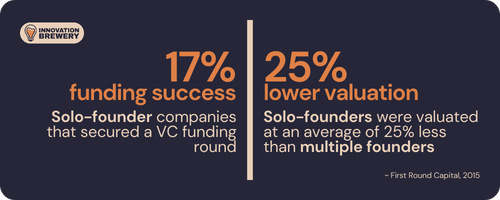
However, gatekeepers of capital remain skeptical about the futures of these single-handed efforts. In the same time periods, solo-preneurs secured only 17% of the venture funding. This disparity shows a profound dissonance in the mindsets of those who have capital to spend, and those who run the businesses.
The irony is palpable, as venture capital holds onto the idea of multiple founders as de-risking strategy, yet co-founder conflict is responsible for as much as 65% of all startup failures. By forcing people into “marriages of convenience,” the industry actually creates the very instability it’s trying to avoid. In 2026, the lone visionary isn’t the risk; they’re the safe bet.The economics of 2026 suggest that a single, lone visionary may no longer be the risk that it was once assumed to be, and may add an element of stability.

The AI Stack is the New Team
How has the solo route gained so much popularity among enterprising business idealists? The answer lies in the democratisation of capabilities. The speed & spread of the “integrated AI stack” means that a single person can now leverage agentic technology to function as a virtual co-founding team. In the past, a designer with unique and complicated technical skills was needed to generate all the media for a startup, but today, a founder can use AI to ideate, iterate, and generate content that is near-perfect for publishing. By sidestepping the designer in the messy ideation phase, the founder can go straight from their refined idea into production quality scopes for a professional agency to simply execute on. No rework, no back-and-forths, no scope changes.
Sam Altman’s once-bold prediction of the “one-person unicorn” is no longer a provocative thought experiment, but rather a mathematical inevitability. When a single founder can orchestrate 15 to 20 AI agents (as McKinsey projected would be common by 2025) the very definition of “human resources” shifts. These agents specialized entities that handle development, marketing, and customer success with a level of precision that previously required a multi-million payroll.
This shift represents a transition from doing to orchestrating. The solo founder of 2026 is less a coder or a salesman and more a conductor. By using low-code platforms and agentic AI (like Claude Code and Jasper), the solo-preneur can scale revenue five times faster than traditional SaaS companies. They are building “AI-only rivals” that compete with existing firms by maintaining minimal overheads and an ability to pivot that is physically impossible for a 50-person team.
Solopreneurs still face challenges

The industry is still lagging in terms of responding to the trend of solopreneurs. Whilst AI might be encouraging more people to take on the risk of starting a new business, there are some tangible obstacles still to overcome.
Notably, whilst revenue is no longer shared between multiple founders, there is a definite revenue gap between single-founder & multi-founder startups or nearly 165%. That is noticed by VCs, who tend to calculate the value of single-founder startups as consistently lower than multi-founders. This leads to fewer successful funding rounds, and lower investments when success is found.
The Sovereignty of the Solo Founder
There is still hope for the solo founder.
The “Shooting Star” model is defined by a specific economic geometry. It prioritizes capital efficiency and high-margin products—MicroSaaS, niche AI applications, and premium digital assets—over the “growth at all costs” mentality that necessitates dilutive VC rounds.
To thrive in this new landscape, the modern founder must internalize four strategic shifts:
- High-Margin Business Models: Target sectors where 60%+ margins are the baseline. If a model requires a massive headcount to scale, it is a relic of the previous decade.
- The Virtual C-Suite: Build a robust AI stack to automate the mundane. Customer support, initial code deployment, and lead generation should be handled by agents, leaving the founder to focus on high-level strategy and creative differentiation.
- Value-Based Pricing: Solo founders should leverage their niche expertise to command premium rates. When your overhead is negligible, your pricing should reflect the outcome delivered, not the hours logged.
- Agility as a Weapon: The primary competitive advantage of the solo founder is the absence of meetings. The ability to prototype, test, and pivot in a single afternoon allows the "Shooting Star" to outrun larger, better-funded competitors who are paralyzed by consensus.
Takeaways
Moving from the “lone wolf” insult to the “one-person unicorn” reality is the biggest change in the history of business. We’re finally realizing that in an AI world, a team of one is often the most stable, profitable, and creative unit.
This isn’t just a trend, it’s a correction. Human collaboration is expensive and friction-heavy. Technology has finally filled the gap. By the end of this decade, the goal won’t be to see how many people you can manage, but how much impact you can make. And you don’t need an army for that. You just need a vision and the right stack.
For a comprehensive look at how to set yourself up for single-founder success, drop us an email and see what we can do for you, including starter-friendly packages.
How Innovation Brewery can help:
Sources
- https://carta.com/data/founder-ownership/
- https://seedblink.com/blog/2024-06-03-the-founder-factor-on-startup-success-solo-vs-co-founders
- https://skaleegenkapital.com/2025/03/11/a-decade-of-startup-dynamics-europe-usa-and-china/
- https://10years.firstround.com
- https://blockchain-founders.io/solo-founder-vs-founding-team-which-is-better-to-start-with/
- https://kenyarmosh.com/blog/solopreneur-business-ideas/
- https://www.mckinsey.com/cn/our-insights/our-insights/beyond-the-hype-unlocking-value-from-the-ai-revolution


