

Stagnant Agile Frameworks
If your “agile transformation” feels more like wading through knee-deep bureaucracy than a quick sprint, you are part of a massive, collective realization. The days of the off-the-shelf frameworks are over. For a decade, we were told that following ceremonies, cadences, and rigid hierarchies would lead to innovation. Instead, most companies ended up in “Agile Theater”: a performance where the words have changed but the underlying command-and-control stayed the same.
The shelf of one-size-fits-all solutions is empty. We are seeing a quiet shift toward the custom-fit.
Large frameworks like SAFe originally promised to bring order to the chaos of enterprise software. They were meant to bridge the gap between coding and the C-suite, yet they often became the very thing they tried to replace: rigid, top-down methods that cared more about the framework than the value delivered.
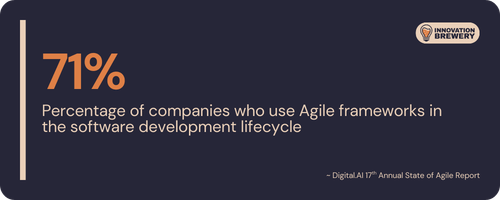
The numbers show people are leaving this thinking behind. While agile adoption is still around 71%, the power of single frameworks is dropping. SAFe usage, for instance, has fallen from its peak down to roughly 26%. The market isn’t buying the “all-in” promise anymore. Now, about 31% of medium and large organizations are moving toward a hybrid model, mixing Scrum, Kanban, Waterfall, and DevOps into something that actually fits their needs.
Fit-for-Purpose
We are moving into a phase where the framework has to serve the company, not the other way around. Leaders don’t care about how to do Scrum “correctly” anymore, instead they’re asking which parts of these methods actually solve their specific bottlenecks.
This is called “Stagility”, the balance between stable foundations (clear strategy and a unified purpose) and the agile responsiveness (the ability to pivot & adapt). Without solid foundations, movement is treacherous and risky. Without the ability to change, stability becomes rigor mortis.
Customisation for Survival
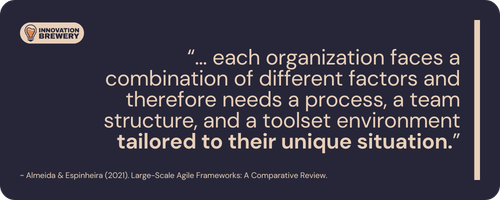
Building a tailored model is now a survival tactic. Roughly 22% of organizations are creating their own internal agile frameworks. In finance and healthcare, this “homegrown” approach is essential. These industries can’t just “move fast and break things.” They need hybrid models that put “compliance squads” right into the teams, making sure mandatory checks happen during the work rather than blocking it at the end. Large organisations have tight budgets, high-risk products, and a need for more analysis and due diligence than a lean & mean startup riding on venture capital.
Tailored frameworks also means we have to stop obsessing over “vanity metrics.” For years, teams focused on “velocity”, a number that’s too easy to game by padding story points. We need to bring focus back to Flow Metrics instead. Cycle time, throughput, and flow efficiency show exactly how long it takes to turn an idea into value for a customer.
Generative AI is speeding up this move toward custom setups. AI makes complex, homegrown processes easier to manage by handling the documentation and coordination that usually slows things down, ensuring that a custom-built system stays lightweight rather than becoming a mess.
Practical Steps for Customising Your Agile Processes
Moving from blind-rigidity to fine-tuned performance requires a change in how we lead. To get past the blueprint:
- Build a toolkit, not a temple: Stop treating frameworks like religions. Find the pieces that work for each use case: use Scrum for iterations, Kanban for flow, and Lean to cut waste.
- Audit your ceremonies: If a stand-up is just a status report for a manager, kill it. If a retrospective doesn’t lead to a real change, it’s a waste. Get rid of anything that’s just for show, or that isn’t achieving its own underlying goals.
- Set your backbone: Before you push decision-making down, make sure everyone knows the "North Star." You can only be fast at the edges if you are solid at the center.
“Customised” isn’t a bad word in organizational design anymore. It’s a sign that a company actually understands its own culture and its own path to value. The future belongs to those who build their own path, not those who follow a pre-drawn map. It’s about flow over volume and purpose over protocol. The era of agile stagnation is over, and the era of Stagility is here.
Sources
- https://digital.ai/resource-center/analyst-reports/state-of-agile-report/
- https://www.researchgate.net/publication/351995797_Large-Scale_Agile_Frameworks_A_Comparative_Review
- https://repository.up.ac.za/items/707cf34a-07e0-4817-b508-72e6cd78e492
- https://pmc.ncbi.nlm.nih.gov/articles/PMC11131107/


